
Spine Second Opinion & Treatment Decision Guidance
Independent Guidance for Complex Spine Treatment Decisions
Comprehensive review of your symptoms, treatment history, and spine imaging to help you make informed decisions about what to do next.
20+ Years in Spine & Pain Medicine | MGH / Harvard Faculty | Former Director of Intervention & Innovation, MGH Center for Pain Medicine | 70+ Pain Physicians Trained
Understand your MRI, your symptoms, and your options before making an important spine treatment decision.
If you have persistent back or neck pain, spinal stenosis, sciatica, spondylolisthesis, or have been told you may need spine surgery, the right next step is not always obvious.
Your MRI may show several abnormalities. Different specialists may recommend different treatments. And you may be wondering:
Do I really need spine surgery? Is there a less invasive option?
Our independent spine consultation provides a comprehensive review of your symptoms, MRI and other imaging, previous treatments, medical condition, and personal goals.
We help you understand which findings are most likely causing your symptoms and compare the reasonable treatment options—from nonsurgical and interventional treatments to minimally invasive or endoscopic procedures, neuromodulation, and conventional spine surgery.
Spine care is often a matter of judgment, not a simple answer from an MRI. We bring clarity to that uncertainty and help you identify the treatment strategy that best fits your individual situation.
The Aging Spine: What Does Your MRI Really Mean?
Many patients come to a spine consultation already focused on a particular finding from their MRI—often a “bulging disc,” “degenerative disc,” “stenosis,” “pinched nerve” or “spondylolisthesis.”
The finding may be real. But that does not necessarily mean it is the cause of the pain.
Degenerative Changes Become Common as We Age
Our spines change throughout life. Discs gradually lose water and height, joints develop arthritis, ligaments may thicken, and the spaces around the spinal nerves can become narrower. As a result, MRI findings that sound concerning become increasingly common with age—even among people who have no back pain at all.
In a large review of MRI and CT studies involving people without symptoms, disc degeneration was found in approximately 37% of people at age 20 and 96% by age 80. Disc bulging increased from about 30% at age 20 to 84% by age 80.
These findings do not mean that disc degeneration or a bulging disc can never cause pain. They mean that seeing an abnormality is not the same as proving that it is the source of the symptoms.
A “Bulging Disc” Does Not Explain Every Backache or Leg Pain
A patient may have a disc bulge on MRI but experience back pain from the facet joints, muscles, sacroiliac region, or another spinal level.
Similarly, leg pain may result from compression of a particular nerve root—but the important question is whether the location of that compression actually matches the patient’s symptoms and neurological findings.
Even severe-looking spinal stenosis may have very different significance in a person who walks several miles without difficulty than in someone whose legs become painful, heavy, or weak after standing for five minutes.
The Images Must Fit the Clinical Story
This is why we review the actual images, rather than relying only on the MRI report.
We look at where the abnormalities are located, which nerves may be affected, how severe the changes really are, and—most importantly—whether those findings make sense in the context of your symptoms.
Sometimes the MRI provides a very clear explanation.
Sometimes several abnormalities could be contributing.
And sometimes the finding that sounds most alarming on the report is not the finding that matters most.
The purpose of a careful spine consultation is not simply to identify what looks abnormal. It is to determine what is clinically important.
Finding the Source of Your Symptoms
Back and leg pain can arise from very different structures. Two patients with nearly identical MRI findings may have very different symptoms—and may need very different treatments.
Often, more than one problem is present at the same time.
When Several Problems Exist at Once
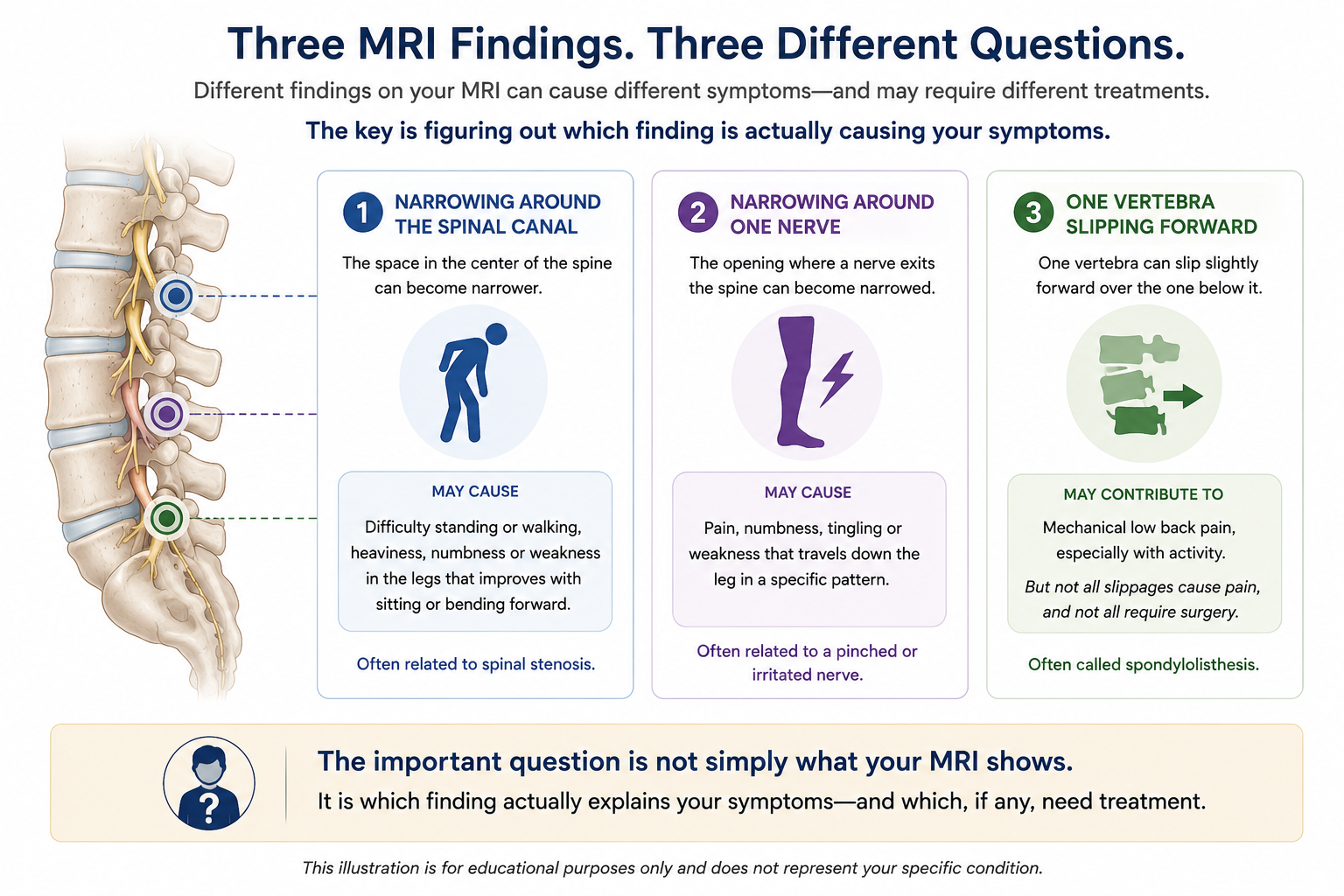
Consider a patient whose MRI shows spinal stenosis at L3–4, spondylolisthesis at L4–5, and narrowing around a nerve at L4–5.
The patient also has both back pain and pain traveling into the leg.
There is no single question called “What is the treatment for this MRI?”
Instead, we ask:
Is the leg pain coming from the L4–5 nerve compression?
Is difficulty walking caused by the L3–4 spinal stenosis?
Is the spondylolisthesis actually contributing to the back pain—or is it simply another degenerative finding?
Does every abnormal level need treatment?
The answers can lead to very different treatment strategies.
Understanding Your Treatment Options
Once we have a clearer understanding of what is causing your symptoms, the next question is:
What are the reasonable ways to treat it—and how do you choose among them?
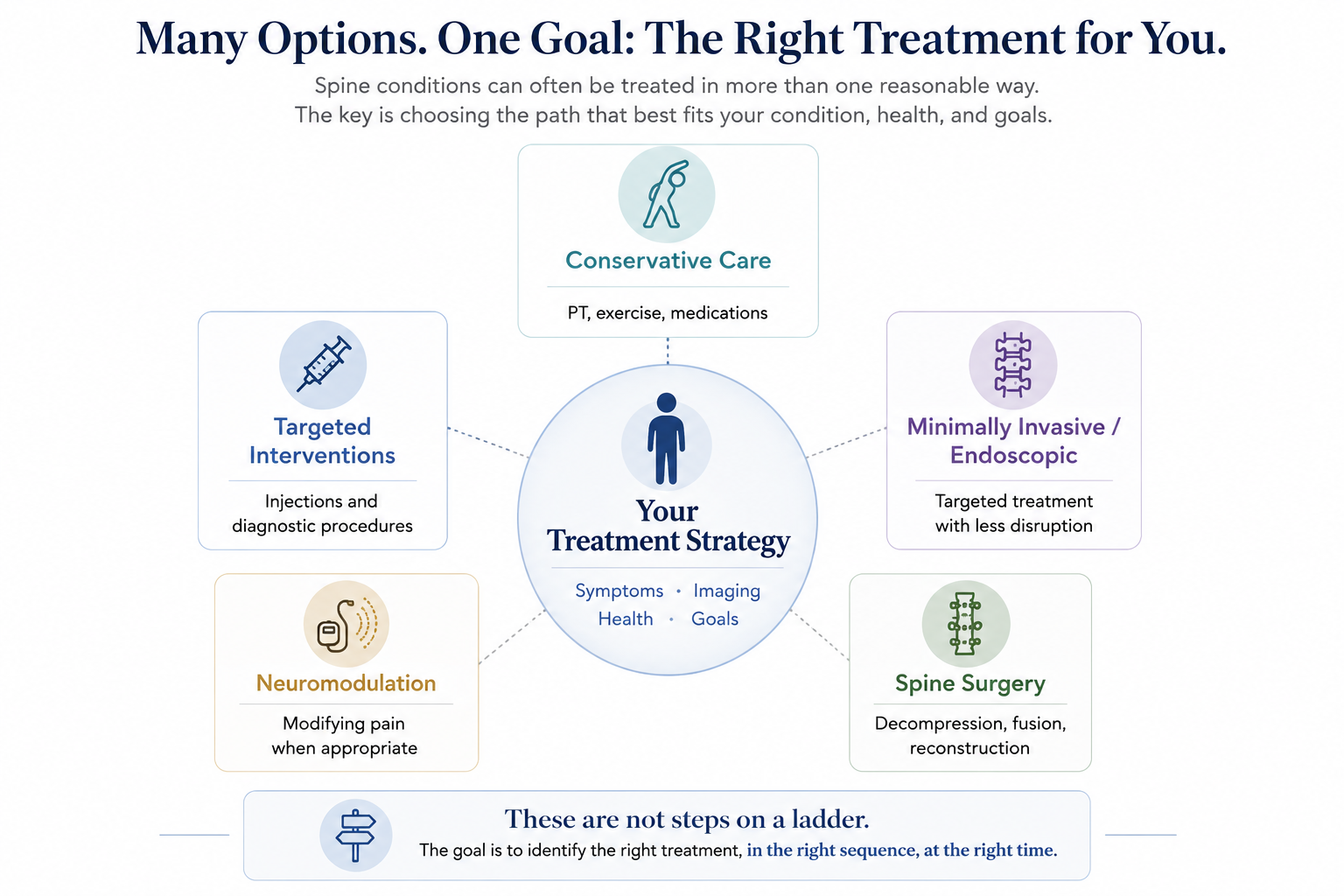
Modern spine care offers many options: physical therapy and medications, targeted injections, minimally invasive and endoscopic procedures, neuromodulation, and conventional spine surgery.
Spine Care Can Be Difficult to Navigate
Patients with persistent spinal pain often move through a complex healthcare system—primary care, physical therapy, pain medicine, radiology, neurology, orthopedic or neurosurgical consultation—sometimes receiving different recommendations along the way.
Meanwhile, months or even years can pass while the patient continues to live with pain and declining function.
Looking at the Options Together
Depending on the problem, we may consider:
Conservative Care
Physical therapy, exercise, medications, activity modification, and time.
Targeted Spine Interventions
Epidural injections, selective nerve root injections, and other image-guided procedures that may provide relief and, in selected situations, help clarify the source of pain.
Minimally Invasive and Endoscopic Treatment
For appropriately selected patients, newer approaches may allow spinal stenosis or nerve compression to be treated through smaller, more targeted procedures while preserving more of the normal spinal structures.
Neuromodulation
Spinal cord stimulation and related therapies may provide another path for selected patients with persistent back or nerve pain, particularly when major reconstructive surgery is not desirable or appropriate.
Spine Surgery and Fusion
For some conditions, conventional decompression or fusion remains the most appropriate treatment, particularly when instability, deformity, significant neurological compromise, or structural reconstruction must be addressed.
Choosing a Path—Rather Than Simply Trying the Next Treatment
These options are not necessarily steps on a ladder, and every patient does not need to progress through all of them.
A thoughtful treatment strategy asks which options actually fit the patient’s condition, which are unlikely to help, and when it makes sense to move from one approach to another.
The goal is to develop a clear path forward—so that valuable time is not lost pursuing treatments that are unlikely to address the real problem.
The least invasive treatment is not always the best treatment. And the most extensive treatment is not necessarily the right choice for every patient.
The right treatment is the one that best matches the problem, the evidence, and the person.
When Age or Medical Complexity Changes the Decision
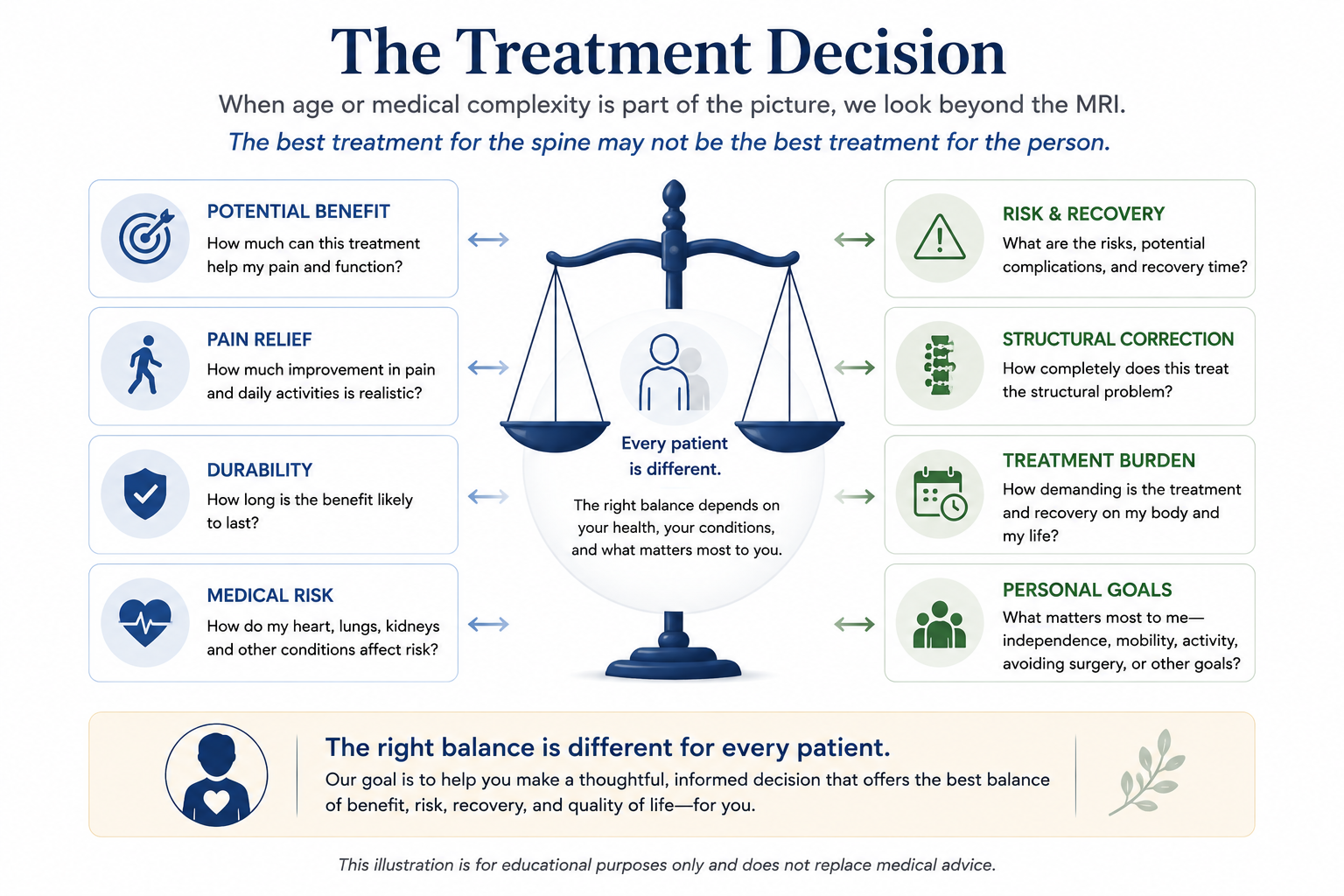
The best treatment on an MRI may not always be the best treatment for the person.
Spine treatment decisions become especially important—and sometimes more difficult—as we get older or develop other medical conditions.
Consider an older patient with spinal stenosis, nerve compression, and spondylolisthesis. From a purely structural perspective, decompression with spinal fusion may be a reasonable recommendation.
We also need to consider the patient’s heart and lung health, kidney function, frailty, medications, anesthesia risk, expected recovery, and—most importantly—what the patient hopes to accomplish.
For one person, the potential long-term benefit of a larger operation may clearly justify the recovery.
For another, the priority may be very different:
Sometimes the Goal Is Not to Fix Everything
An aging spine may have multiple structural problems. It is not always necessary—or desirable—to correct every abnormality.
For selected patients, more focused treatments may provide meaningful improvement without requiring a major reconstructive operation.
These treatments are not substitutes for surgery when surgery is clearly necessary. But they can provide important alternatives when the patient’s anatomy, medical risk, or personal priorities make a larger operation less attractive.
How We Evaluate Your Spine Problem
A Comprehensive Review—Not Just Another Look at Your MRI
A meaningful spine consultation begins with understanding the whole clinical story.
Before making recommendations, we bring together your symptoms, treatment history, actual imaging, overall health, and personal priorities. We then examine how well these pieces fit together.
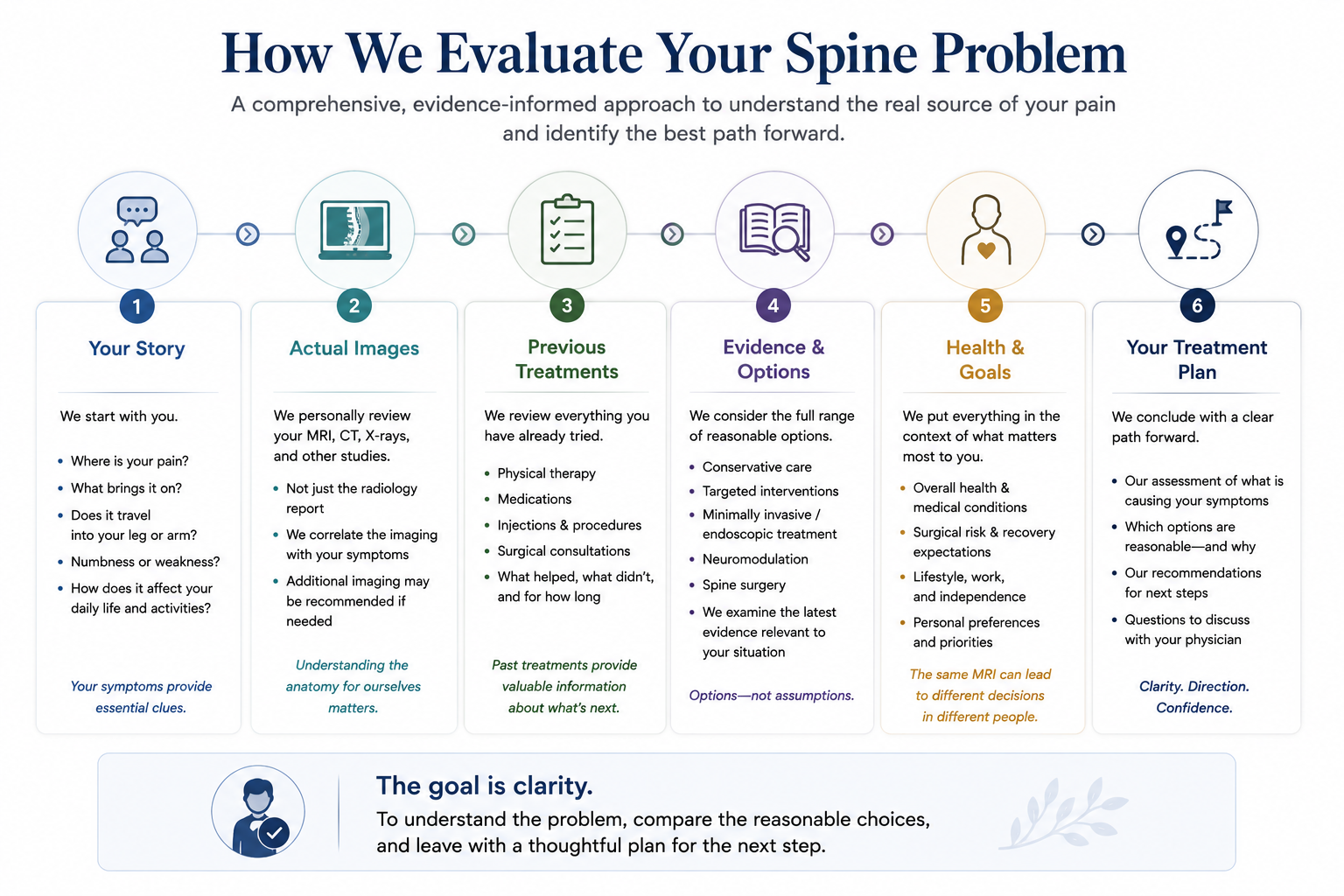
1. Understand Your Symptoms
We start with what you are actually experiencing.
Where is the pain? What brings it on? Does it travel into the leg or arm? Is there numbness or weakness? How far can you walk? What activities have you stopped doing because of the problem?
These details often provide the first clues about which findings on the imaging are clinically important.
2. Review Your Actual Images
We review the relevant MRI, CT, X-rays, and other available studies—not simply the written radiology report.
The goal is to understand the anatomy ourselves and determine whether the imaging findings correspond to your symptoms.
When needed, we may identify additional imaging or diagnostic information that could help clarify the decision.
3. Understand What Has Already Been Tried
We review previous physical therapy, medications, injections, procedures, and surgical consultations—including what helped, what did not.
A treatment that failed can still provide useful information about the source of the pain and what should—or should not—come next.
4. Consider the Full Range of Reasonable Options
We consider the relevant treatment pathways together rather than looking at the problem through the lens of a single procedure.
Depending on your condition, this may include continued conservative care, targeted interventions, minimally invasive or endoscopic treatment, neuromodulation, or conventional spine surgery.
When an important decision depends on evolving medical evidence, we examine the relevant research and how well it applies to your particular situation.
5. Put the Decision in the Context of Your Health and Goals
The same MRI may lead to different treatment decisions in different people.
Age, medical conditions, surgical risk, recovery expectations, lifestyle, work, independence, and personal preferences all matter.
6. Develop a Clear Path Forward
The consultation concludes with our assessment of what is most likely causing your symptoms, which treatment options are reasonable, and our recommendations for what to do next.
When appropriate, we also identify questions to discuss with your surgeon or treating physician and whether another specialist opinion may be valuable.
The goal is clarity: to understand the problem, compare the reasonable choices, and leave with a thoughtful plan for the next step.
Academic Medicine Expertise — A Treatment-Neutral Perspective

20+ Years in Spine & Pain Medicine | MGH / Harvard Faculty | 70+ Pain Physicians Trained | Advanced Interventional & Neuromodulation Expertise
Expertise Across the Full Spectrum of Spine Care
More Than 20 Years of Experience in Spinal Pain Management
For more than two decades, Dr. Jin has specialized in the evaluation and treatment of spinal pain, caring for patients across the full spectrum of spine conditions—from common back and neck pain to spinal stenosis, radiculopathy, degenerative disease, and persistent pain after spine surgery.
Dr. Jin is a faculty physician at Massachusetts General Hospital and Harvard Medical School and formerly served as Director of Intervention & Innovation at the MGH Center for Pain Medicine.
Throughout his academic career, he has helped train more than 70 pain medicine physicians, bringing together clinical experience, evidence-based medicine, and advances in interventional spine care.
This breadth of experience provides an important perspective when evaluating a difficult spine decision.
Understanding these options requires more than knowing that they exist. It requires understanding what each treatment can accomplish, what it cannot accomplish, the evidence behind it, and which patients are most likely to benefit.
Dr. Jin approaches each consultation from this broader perspective—integrating the patient’s symptoms, imaging, previous treatment, overall medical condition, current evidence, and personal goals.
The objective is not to promote a particular procedure, but to help patients understand their choices and determine which treatment strategy makes the most sense for them.